
EMDR vs. Brainspotting: What’s the Difference, and Which One Might Help You Heal?
If you’ve been carrying trauma, chronic stress, or attachment wounds, you may know the feeling of being tired of understanding your patterns but still feeling stuck in them.
Maybe you’ve done talk therapy. Maybe it helped in some ways. But maybe there’s still a part of you that gets activated fast, shuts down, people-pleases, panics, or goes numb — even when you know better.
This rinse-and-repeat pattern can feel relentless and hopeless.
That’s often where therapies like EMDR and Brainspotting come in.
Both are designed to help process trauma more deeply than traditional talk therapy alone. Both work with the brain and nervous system, not just your thoughts. And both can be powerful. But they are not exactly the same.
What EMDR and Brainspotting have in common
EMDR and Brainspotting are both trauma-focused approaches that help your brain process experiences that may feel “stuck.”
When trauma hasn’t fully processed, it can keep showing up in everyday life as:
emotional overwhelm
shutdown or numbness
people-pleasing
chronic tension
feeling unsafe even when nothing is “wrong”
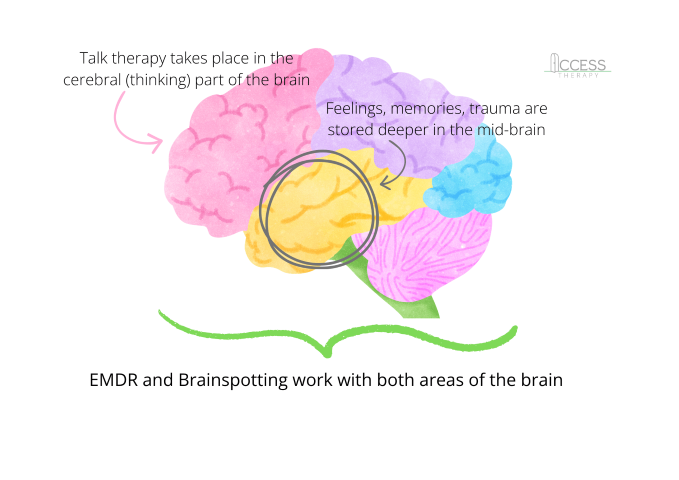
Both EMDR and Brainspotting are meant to help your system move through what talk therapy sometimes cannot fully reach because it lives in the subcortical part of the brain - not the verbal/processing part.
In simple terms: they do not just help you talk about what happened — they help your brain and body process it.
If this is hitting a note for you, consider reaching out to see if EMDR or Brainspotting are right for you. You can book a Free Consultation with us to see if a professional can help you navigate deeper levels of healing.

What is EMDR?
EMDR stands for Eye Movement Desensitization and Reprocessing.
It’s a structured trauma therapy that helps you process distressing memories using bilateral stimulation — usually side-to-side eye movements, tapping, or sounds.
During sessions, your EMDR therapist helps you focus on a specific memory, belief, body sensation, or emotional experience while engaging in bilateral stimulation. Over time, the memory often becomes less intense, less overwhelming, and less “live” in your nervous system.
People often choose EMDR when they want support with:
PTSD or single-incident trauma
anxiety linked to past experiences
painful memories that still feel very charged
negative beliefs like “I’m not safe,” “I’m not enough,” or “It was my fault”
EMDR can feel helpful if:
✓ You like a more structured process.
✓ You want a therapy with a clear framework.
✓ You feel ready to work directly with specific memories.
Seeking the support of an EMDR therapist can help you approach the deeper layers of trauma.You can book a Free Consultation with us to see if an EMDR professional can help you navigate a new path forward.

What is Brainspotting?
Brainspotting is another trauma therapy, but it is often less structured and more body-led.
It works on the idea that where you look affects how you feel. A therapist helps you find a specific eye position — called a “brainspot” — that seems connected to a stuck emotional or body experience. From there, you stay with what comes up, allowing the brain and body to process at a deep level.
Brainspotting often involves less talking and more noticing. It can feel gentler, deeper, or more intuitive for some people.
It is often helpful for:
trauma and developmental trauma
attachment wounds
chronic activation or shutdown
emotions that feel hard to explain in words
people who feel a lot in their body but struggle to “talk it out”
Brainspotting can feel helpful if:
✓ You want something less structured.
✓ You feel more connected to your body than to words.
✓ You have trauma that feels layered, relational, or hard to explain.
If it feels like your wounds/trauma is stuck in your body and you just don’t have the words for them, don’t hesitate to seek help. Brainspotting therapy can provide valuable support even when words fail you, book a free consultation to speak with a compassionate therapist. This is confidential care.
The biggest difference between EMDR and Brainspotting
The simplest way to say it is this:
EMDR is more structured.
Brainspotting is more attuned and open-ended.
EMDR tends to follow a clear protocol. Your therapist helps guide the process step by step.
Brainspotting tends to slow things down and follow what your nervous system is showing in the moment.
Neither is “better.” It really depends on you.
Some people feel safer with EMDR because it has more structure.
Some people feel safer with Brainspotting because it allows more space, less pressure, and deeper tracking of the body.

Is EMDR or Brainspotting better for trauma and attachment wounds?
For many people with attachment trauma, developmental trauma, or long-term relational wounds, the answer is not just “Which technique works best?”
The better question is: What kind of therapeutic relationship helps me feel safe enough to process?
That matters because healing trauma is not only about method. It is also about nervous system safety, pacing, trust, and feeling deeply supported.
If your wounds were shaped in relationships, then healing often needs to happen in relationship too.
That means the right therapist matters just as much as the right modality.
Is EMDR or Brainspotting better than talk therapy?
Not exactly better — but often different, and sometimes more effective for trauma.
Talk therapy can be incredibly valuable. It can help with insight, self-awareness, coping skills, and emotional support.
But trauma is not always stored in a way that can be fully resolved by talking alone.
That is why some people say things like:
“I understand my triggers, but I still have them.”
“I can explain my story, but my body still reacts.”
“I know this relationship is safe, but I still feel afraid.”
EMDR and Brainspotting can help reach those deeper layers.
How to choose between EMDR and Brainspotting
You do not need to pick perfectly. You just need a starting point.
A free consultation is meant to help you decide what fits your needs, your history, and your nervous system.
You may benefit from EMDR if you want structure and a focused approach.
You may benefit from Brainspotting if you want a slower, body-based, more intuitive process.
And sometimes, the best care includes more than one approach over time.
Final thoughts
If talk therapy has helped but you still feel stuck, that does not mean you are broken. It may simply mean your system needs a different path to healing.
EMDR and Brainspotting are both powerful options for trauma healing. The right fit depends on your story, your nervous system, and the kind of support that helps you feel safe enough to go deeper.
You do not have to keep white-knuckling your way through patterns that were shaped by pain.
Healing is possible. And it does not have to happen through words alone.
Remember, you’re not alone in this journey, and help is available. Take the first step today—reach out and seek the support you deserve.
